
People mention blockchain all the time. It often sounds like a complicated tech mystery, but the main idea is actually simple. It’s a way for people and computers to agree on information without needing a central authority.
If that still feels abstract, relax. We’ll go through what it really is, how it works, and why it matters, step by step, in plain language.
1. What blockchain actually is
A blockchain is a digital record that everyone can see but no one can secretly rewrite. Imagine a shared notebook that many people use at once. Each time someone adds a note, it stays there forever. You can add new pages, but you can’t erase old ones.
Each page in that notebook is a block. When one fills up, another page gets added and linked to the previous one. Those links create the chain.
Inside every block, there are three key things:
-
A list of transactions or data entries
-
A timestamp showing when it was added
-
A unique code called a hash, which connects it to the previous block
Because each block depends on the one before it, changing old data would break the entire chain. That connection keeps everything secure and honest.
2. Why it’s decentralized
Most systems we use today have a central controller. A bank, a company, or a government keeps all the records, decides what’s valid, and has the power to alter them. Blockchain is different.
Copies of the same record exist on thousands of computers called nodes. Every node holds the full transaction history and constantly checks it against others. If one copy is wrong, the rest of the network ignores it.
That’s what decentralization means. No one owns the system. No single point can be shut down or corrupted. It works because everyone participates and verifies one another’s work.
3. How the network agrees on truth
A blockchain only works if all participants agree on what’s real. This agreement is called consensus.
When people make new transactions, they’re grouped into a block. Before the network adds that block to the chain, every node checks it carefully. They make sure the transactions follow the rules and that nobody is spending the same funds twice.
Different networks use different methods to reach consensus:
-
Proof of Work (PoW): Used by Bitcoin. Computers race to solve a tough math puzzle. The first to finish adds the block and gets rewarded.
-
Proof of Stake (PoS): Used by Ethereum, Cardano, and others. Participants lock up some of their coins as a deposit. Honest behavior earns rewards, while cheating causes them to lose part of their stake.
Both systems make honesty profitable and cheating expensive.
4. What happens during a transaction
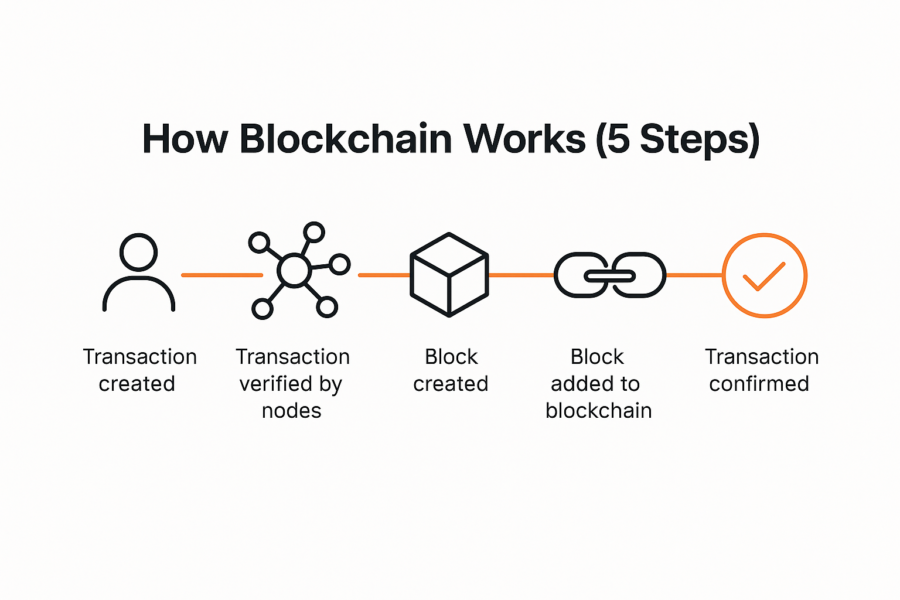
Let’s say you send one Bitcoin to your friend. Here’s what happens behind the scenes:
-
You create a transaction in your crypto wallet.
-
The transaction goes to the network, where all nodes can see it.
-
The network checks that you actually own the Bitcoin you’re trying to send.
-
Once confirmed, your transaction is grouped with others into a block.
-
Miners or validators verify the block and connect it to the blockchain.
-
Once added, your transaction becomes permanent.
Now your friend has the Bitcoin. The whole process usually takes from a few seconds to several minutes, depending on the network.
5. Why it’s called blockchain
The name says it all. It’s literally a chain made of blocks. Each block holds data, and every new one connects to the last. Because of that link, the system becomes extremely hard to alter.
If anyone tries to change one block, its hash no longer matches the next one. The network spots the mismatch instantly and rejects the tampered copy.
That’s why blockchain is considered one of the most transparent and secure technologies ever built.
6. The role of cryptography
The “crypto” part in cryptocurrency comes from cryptography. It’s the math that keeps everything safe.
Each user has two digital keys:
-
A public key, similar to an email address. It identifies you on the network.
-
A private key, like a password. It proves that you control your funds.
When you send crypto, you sign the transaction with your private key. The network checks the signature using your public key. That’s how it confirms the transaction really came from you.
Even if someone sees your transactions, they can’t access your coins without your private key.
7. Why blockchain is secure
Blockchain security comes from how it’s built. There are three main strengths.
-
Distribution. The same data lives on thousands of computers. To hack it, someone would have to change most of them at once, which is nearly impossible.
-
Mathematical linking. Every block depends on the one before it. If one changes, everything that follows breaks.
-
Consensus rules. Only valid, verified transactions are accepted by the network.
Even if one computer fails, the rest continue as normal. That’s why blockchain networks rarely go down or lose data.
8. Real-world uses
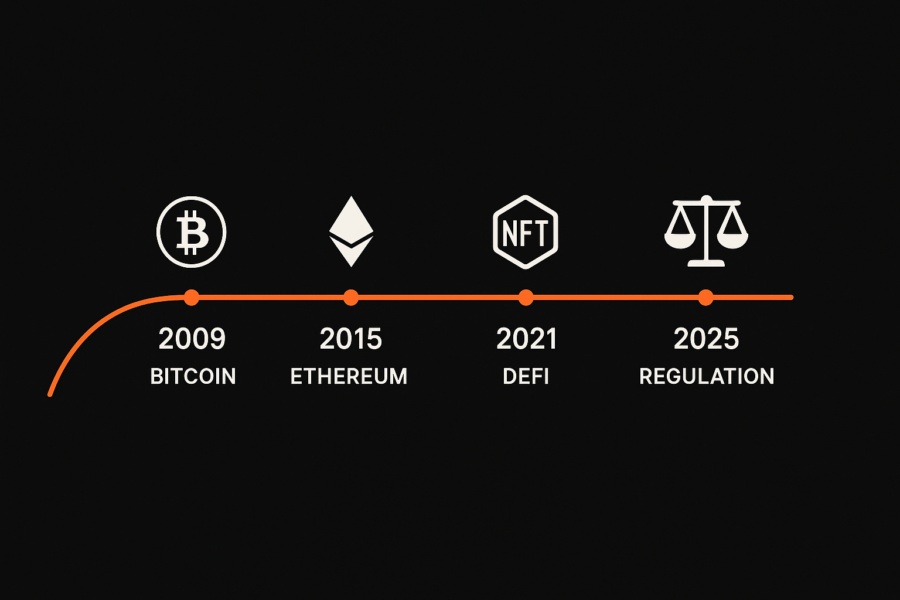
Blockchain started with Bitcoin, but now it powers a wide range of industries.
-
Finance: Faster, cheaper global payments.
-
DeFi (Decentralized Finance): Loans, trading, and savings without banks.
-
NFTs: Digital ownership of art, music, or collectibles.
-
Supply chains: Verifying where products come from.
-
Voting: Secure, transparent digital elections.
-
Healthcare: Safe sharing of medical records.
All these examples rely on the same principle: a shared record that everyone can trust.
9. The drawbacks
Blockchain isn’t perfect. Like any system, it has weaknesses.
-
Speed: Bitcoin handles only a handful of transactions per second. Payment processors handle thousands.
-
Energy: Proof of Work uses a lot of electricity.
-
Complexity: Wallets, private keys, and backups can confuse beginners.
-
Scams: Fake projects still appear.
-
Regulation: Governments are still figuring out how to apply laws.
Developers are improving things with faster blockchains, greener systems, and user-friendly designs.
10. Why it matters
Blockchain changes how people think about trust. In traditional systems, you rely on banks or companies to keep things honest. In blockchain, you rely on math and open rules.
That’s why people call it a trustless system. It doesn’t mean there’s no trust. It means trust is built into the code itself.
When information can’t be secretly changed, strangers can do business safely. That simple shift opens a world of possibilities.
11. Why beginners should care
You don’t need to be a developer or a trader to understand blockchain. Just knowing how it works helps you navigate the digital world more safely.
It lets you spot scams, understand how cryptocurrencies function, and appreciate why transparency and security matter. You’ll also see which projects are real and which are hype.
As the technology grows, it’s showing up everywhere from payments to identity systems. Learning the basics now gives you a major advantage later.
12. Quick summary
Blockchain is a shared digital record that keeps data honest. Each block connects to the one before it, and everyone helps maintain the system.
No one can secretly rewrite history. No one needs to be in charge for it to work. The system runs itself through math, verification, and cooperation.
It’s a simple but powerful solution to one of the oldest problems on the internet: how to trust people you don’t know.
13. Final thoughts
Blockchain isn’t a passing trend or a quick way to get rich. It’s a foundation for how future systems will share and secure information.
You don’t need blind trust anymore. You can verify everything yourself.
Once that idea clicks, cryptocurrency stops feeling mysterious. It becomes logical, even practical. And that’s the real power of blockchain — turning trust into something that can be verified instead of promised.

